Why More and More Foreigners in the Czech Republic Start Speaking Czech Only After Several Years — and How It Affects Work, Housing, and Life
Many foreigners move to the Czech Republic with the idea that they can learn Czech “later.” Especially when they are surrounded by Russian-speaking or Ukrainian-speaking chats, friends, and jobs that do not require language skills.
In practice, language becomes one of the main reasons why some people still do not feel fully adapted even after several years of living in the Czech Republic.
At the same time, in 2026 employers and landlords are increasingly paying attention even to basic knowledge of the Czech language.
Why Many People Postpone Learning the Language
After relocation, most foreigners face more urgent priorities:
- finding work;
- housing;
- documents;
- family adaptation;
- financial issues.
Because of this, learning the language often becomes secondary.
Especially if a person:
- works in a Russian-speaking team;
- communicates only within their own community;
- lives in Prague;
- uses translators and online services.
But over time, the lack of language skills begins to limit almost every area of life.
How Language Affects Salary and Work
In 2026, the Czech labor market is gradually changing.
While previously many jobs required no language skills at all, employers are now increasingly searching for workers with at least basic Czech.
- more job opportunities become available;
- salaries are higher;
- career growth inside companies becomes easier;
- communication with colleagues and clients becomes simpler.
This especially applies to stable official employment rather than temporary side jobs.
Why It Is Harder to Rent Housing Without the Language
Many foreigners are surprised by how strongly language affects apartment rentals.
Landlords usually feel more comfortable with tenants who:
- understand basic Czech;
- can read contracts;
- are able to communicate normally about everyday issues.
Without language skills, foreigners more often face:
- intermediaries;
- misunderstanding of conditions;
- problems with deposit returns;
- fake listings.
Why Adaptation in Prague and Smaller Cities Is Different
In Prague, many people can live for years almost without speaking Czech.
But outside the capital, the situation is completely different.
- less English is spoken;
- there is less international environment;
- there is more communication with local residents;
- Czech is needed more often in everyday life.
That is why people in smaller cities usually begin learning the language much faster.
What Mistakes Foreigners Most Often Make
According to Czech integration centers, many foreigners make the same mistakes:
- postponing the language “for later”;
- communicating only within their diaspora;
- being afraid to speak with mistakes;
- studying only theory without practice.
At the same time, even a basic conversational level greatly simplifies everyday life.
Source: https://www.integracnicentra.cz/
Why the Czech Republic Is Strengthening Integration of Foreigners
In recent years, the Czech Republic has gradually strengthened requirements for the integration of foreigners.
In many cases, people with long-term residence permits must complete adaptation and integration courses.
These courses explain:
- how the document system works;
- how healthcare works;
- what rights and responsibilities foreigners have;
- how the Czech system of life and work functions.
Source: https://aik.icpraha.com/ru/
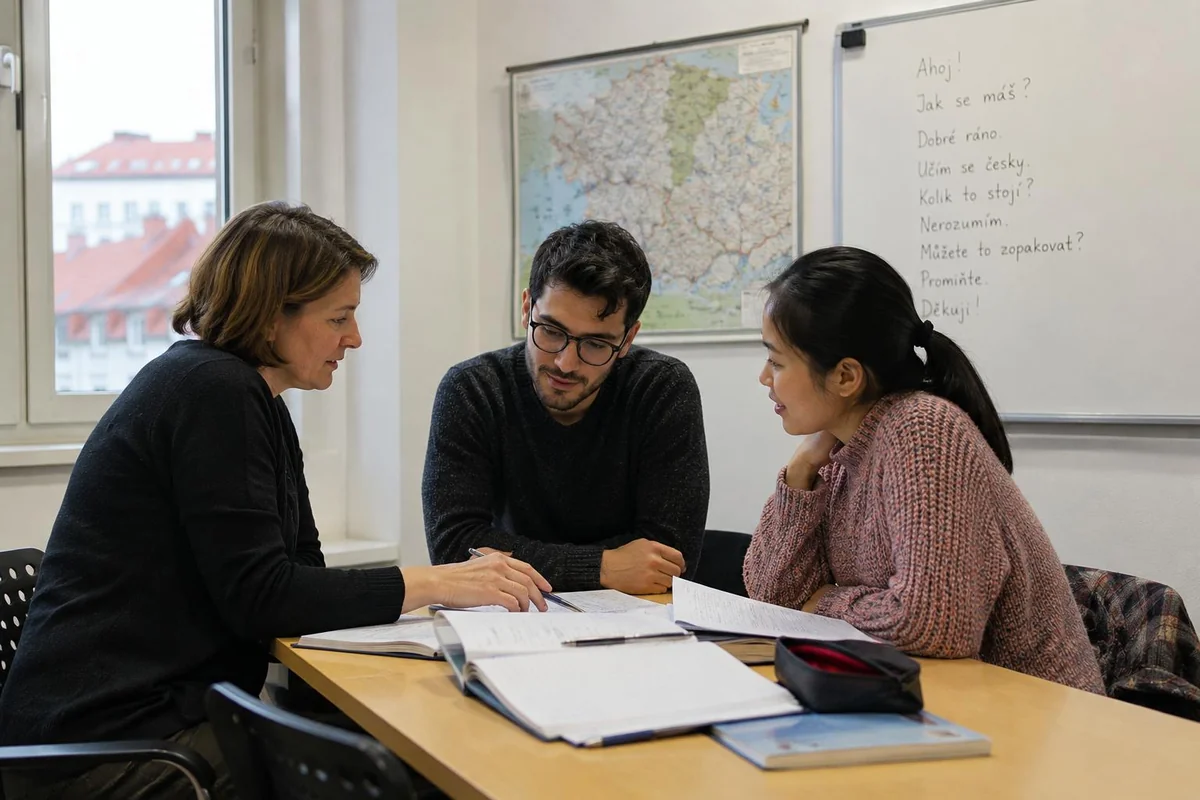
What Actually Helps People Adapt Faster
People who begin feeling comfortable in the Czech Republic the fastest usually:
- learn the language from the first months;
- work officially;
- communicate with local residents;
- are not afraid of everyday communication;
- try to understand local rules and culture.
Even a minimal level of language knowledge strongly changes the attitude of employers, doctors, and landlords.
How praga.work Helps Foreigners
On praga.work, employers often immediately specify:
- language requirements;
- conditions for foreigners;
- official employment;
- information about housing and documents;
- the possibility of fast direct contact.
This helps people understand the real requirements of vacancies in advance and adapt faster after relocation.
Conclusion
In 2026, it is still possible to live in the Czech Republic without knowing the language, especially in Prague.
However, the Czech language increasingly affects quality of life, salary levels, housing opportunities, and the ability to feel comfortable in the country in the long term.