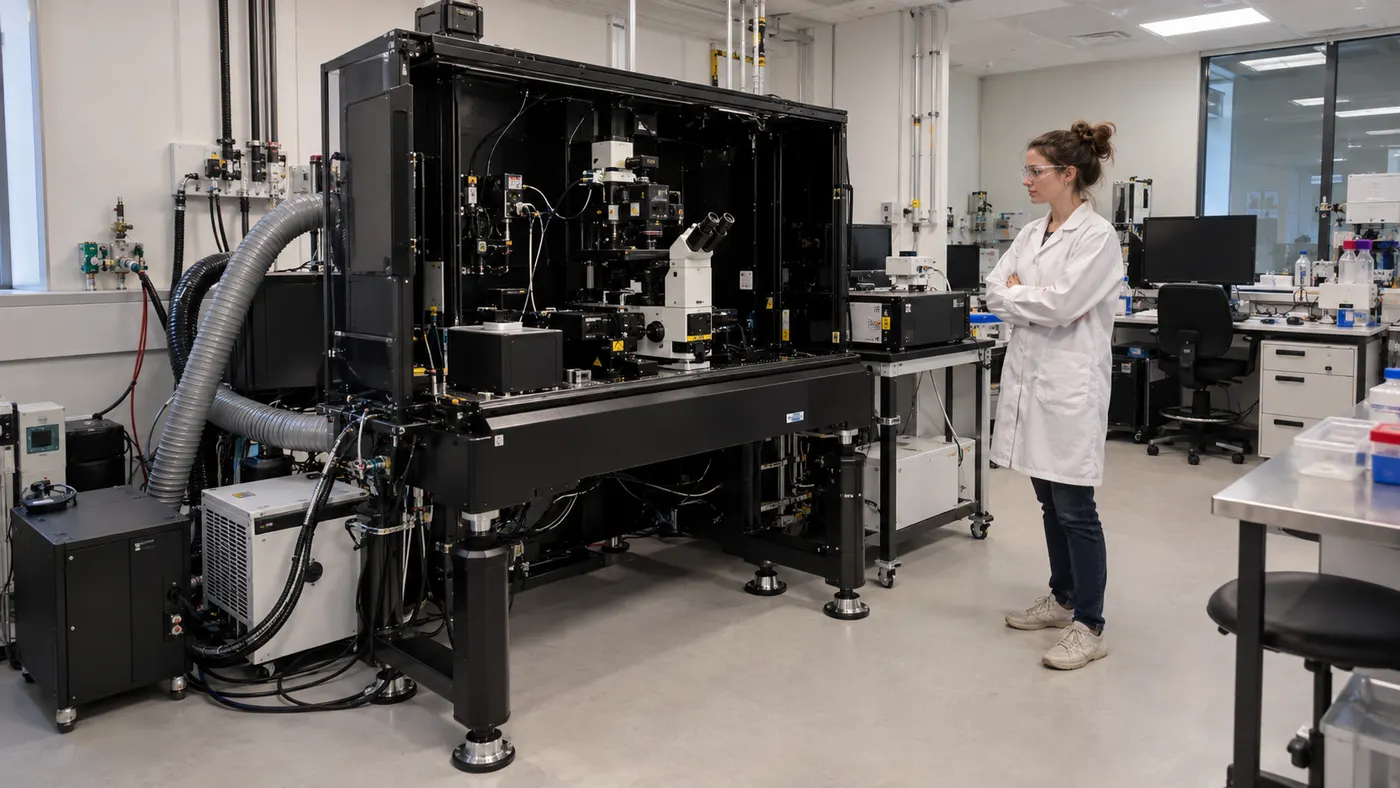
UK scientists unveil Curie microscope capable of imaging structures just 20 nanometers wide
Scientists in the UK have begun using a powerful new microscope called Curie to investigate inflammatory bowel diseases, including Crohn’s disease and ulcerative colitis. The instrument can reveal structures inside living cells measuring around 20 nanometers.
Researchers hope the technology will help uncover fundamental mechanisms behind these conditions and explain what goes wrong inside intestinal cells as the diseases develop.
Curie offers around 10 times higher resolution
The microscope is located at the Rosalind Franklin Institute in Oxfordshire. According to The Guardian, Curie provides roughly 10 times the resolution of conventional light microscopy.
The system uses STED, or stimulated emission depletion microscopy. The technique uses two lasers to distinguish extremely small structures inside cells that would otherwise be difficult to observe with conventional optical microscopes.
Scientists can observe living intestinal cells
Curie is equipped with deformable mirrors and temperature-control technology, allowing researchers to study living samples under conditions close to human body temperature.
- resolution reaches approximately 20 nanometers;
- protein complexes inside cells can be examined;
- samples can be observed while they are still alive;
- researchers can compare cellular changes at different stages.
How Curie could help Crohn’s disease research
The research team is examining protein complexes in intestinal cells to determine which processes change in inflammatory bowel disease. Crohn’s disease and ulcerative colitis are chronic inflammatory conditions whose underlying mechanisms are still not fully understood.
The new microscope is not itself a treatment and does not mean a cure has been discovered. Instead, it gives scientists a much more detailed view of processes occurring inside living cells. In the future, understanding these mechanisms could help researchers identify more precise targets for new therapies.