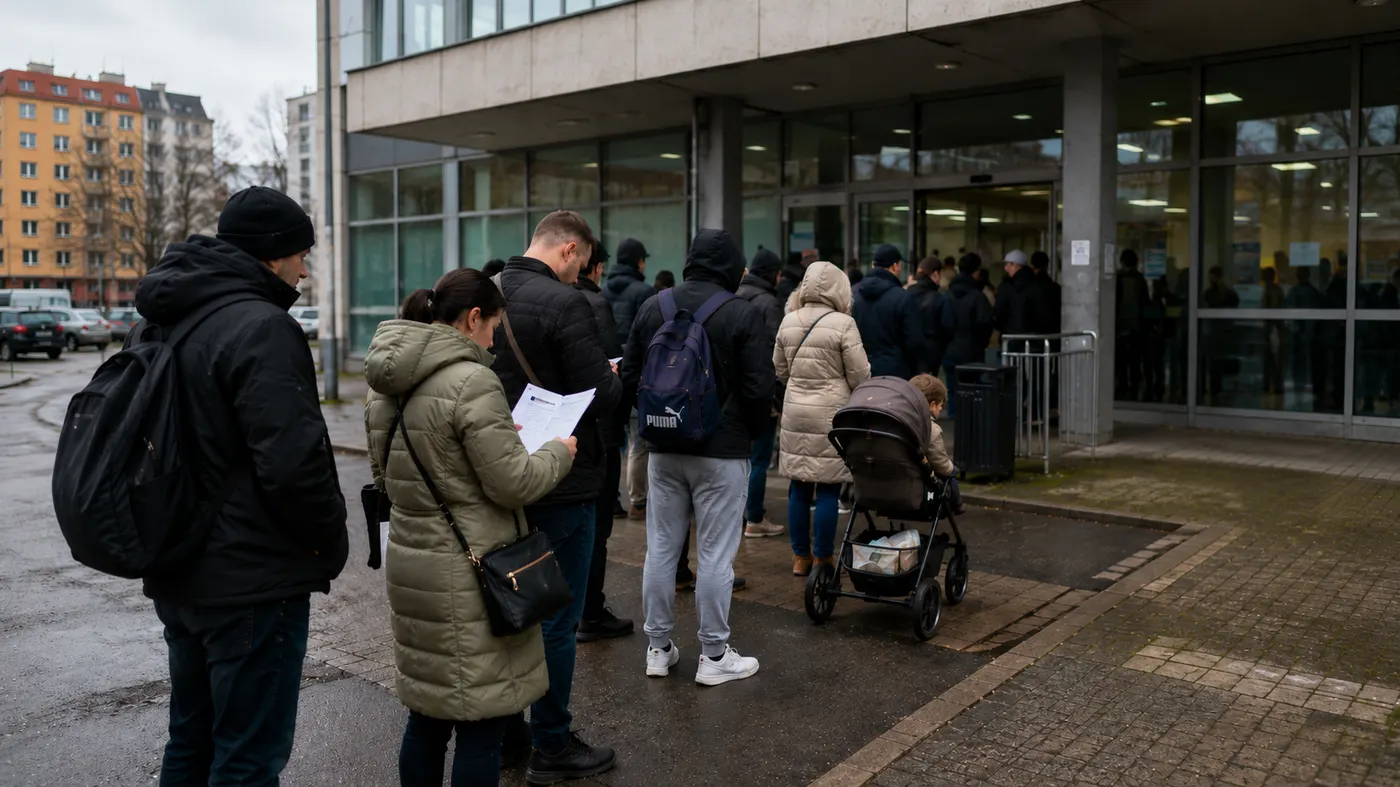
Temporary Protection in the Czech Republic in 2026: Work, Housing, Health Insurance and Documents
Temporary protection in the Czech Republic allows people who left Ukraine because of the war to reside legally in the country, work without a separate work permit, participate in the public health insurance system and apply for assistance provided by law. However, a visa sticker alone does not resolve every administrative matter: holders must monitor the validity of their protection, report their residential address correctly, check who pays their health insurance and retain documents proving their legal employment and accommodation.
In 2026, it is particularly important to distinguish between online registration and the final completion of the temporary protection extension. Successful online registration extended temporary protection until 30 September 2026. After attending an appointment at the Ministry of the Interior and receiving a new visa sticker, protection is extended until 31 March 2027. Missing either stage may result in the loss of legal residence, access to employment and participation in public health insurance.
This article explains what temporary protection in the Czech Republic provides and how it affects employment, rented accommodation, address registration, health insurance, humanitarian assistance and essential documents. The information is especially important for people who already live in the Czech Republic, are changing their job or accommodation, are completing the extension process or are preparing to apply for protection.
What temporary protection in the Czech Republic means
Temporary protection is a special residence status created for people who were forced to leave Ukraine because of the armed conflict. It is not a tourist visa, an Employee Card or permanent residence.
The main rules are regulated by legislation commonly referred to as Lex Ukraine. Official and regularly updated information is published on the Information Portal for Foreigners of the Czech Ministry of the Interior.
A holder of valid temporary protection receives:
- the right to reside legally in the Czech Republic;
- free access to the Czech labour market;
- access to the public health insurance system;
- access to education for children;
- the possibility of applying for humanitarian assistance when the relevant conditions are met;
- access to integration, counselling and language programmes.
Temporary protection remains valid only until the date specified in the relevant document and is connected with several obligations. Holders must report changes of address, keep their documents valid, monitor their health insurance and complete the extension procedure on time.
Who may receive temporary protection
Temporary protection is intended primarily for Ukrainian citizens who lived in Ukraine before 24 February 2022 and left the country because of the full-scale Russian invasion.
In circumstances defined by law, protection may also be available to:
- family members of Ukrainian citizens;
- stateless persons who received international or another form of protection in Ukraine;
- family members of such persons;
- certain foreign nationals who had permanent residence in Ukraine and cannot return safely to their country of origin.
Each application is assessed individually. Ukrainian citizenship alone may not always be sufficient. During a first or repeated application, the Ministry of the Interior may examine where the applicant lived before the beginning of the full-scale war, when they left Ukraine, which residence permits they previously held and whether they have protection in another EU country.
Can a person hold temporary protection in two EU countries?
No. Temporary protection should be active in only one European Union member state. Receiving temporary protection in another EU country is a reason for Czech temporary protection to end.
If a person already holds temporary or international protection in another EU state, an application in the Czech Republic may be considered inadmissible. Before relocating, the person should first clarify how to terminate the previous protection and only then deal with the new residence status.
Temporary protection granted by another EU country does not automatically provide free access to the Czech labour market. A person needs an appropriate Czech residence and employment basis to work legally in the Czech Republic.
How to apply for temporary protection
An application must be submitted in person. Most newly arrived applicants apply at a Regional Assistance Centre for Ukraine, known as KACPU, according to their actual place of residence. In certain non-standard situations, the application is handled directly by an office of the Department for Asylum and Migration Policy of the Ministry of the Interior.
An applicant will usually need to provide:
- a completed application form;
- a valid passport or another identity document;
- documents proving residence in Ukraine on 24 February 2022;
- documents showing that the person left because of the armed conflict;
- documents proving family relationships when applying for a child or with family members;
- proof of accommodation in the Czech Republic;
- a photograph when required in the particular case.
An application may sometimes still be possible without a valid passport, but verifying the applicant’s identity can take longer. The Ministry of the Interior does not guarantee that temporary protection will be granted on the same day the application is submitted.
Which accommodation document is required?
When applying for temporary protection, the applicant will generally need to prove where they live in the Czech Republic. Appropriate evidence may include:
- a rental agreement;
- a sublease agreement;
- written confirmation of accommodation;
- confirmation issued by a legal entity providing accommodation;
- proof of accommodation within the state humanitarian housing system.
If separate written confirmation from the owner or an authorised user of the property is submitted, the signature will normally need to be officially certified. Official certification is generally not required for a rental or sublease agreement, although the Ministry of the Interior may request additional evidence.
If the document is signed by someone other than the owner, evidence of that person’s authority to provide accommodation may also be needed. This could be a power of attorney, a rental agreement or another document connecting the signatory with the property owner.
Extending temporary protection in 2026
In 2026, the extension procedure consisted of two stages. The first was online registration, and the second was an in-person visit to a Ministry of the Interior office.
Online registration for the extension ended on 15 March 2026. After successful registration, the person received confirmation by email, an appointment date and a PIN code.
The electronic confirmation extended temporary protection until 30 September 2026. A PDF confirmation can be downloaded from the user account on the official portal.
To complete the procedure, the person must attend the booked appointment at a Ministry of the Interior office. After a new visa sticker is placed in the travel document, temporary protection is extended until 31 March 2027.
What to bring to the appointment
The applicant should bring a valid passport, if they have one, or another document proving their identity.
Additional documents may include:
- documents proving the right to represent a child under 15;
- a recent passport-sized photograph of the child if the child will not attend in person;
- a rental agreement or confirmation of accommodation if the address has changed and has not yet been reported;
- a new passport if the previous travel document has been replaced;
- the online registration confirmation and appointment details.
Reporting a new address or passport only during the extension appointment does not replace the legal obligation to report the change within the required period. A fine may be imposed for late notification.
What happens if online registration was missed?
If a holder did not complete online registration by 15 March 2026, their temporary protection expired on 31 March 2026.
The person may subsequently submit a new application, but it will be assessed as a new repeated application. The Ministry of the Interior will again examine whether the current eligibility conditions are fulfilled. There is no automatic guarantee that protection will be granted again.
Receiving temporary protection again does not restore the continuity of the previous period of residence. This may be important for a later transition to special long-term residence or other procedures in which uninterrupted residence is assessed.
A repeated application also does not create a new entitlement to benefits that are limited to the first months following the initial grant of temporary protection.
What temporary protection means for employment
A holder of valid Czech temporary protection has free access to the labour market. This means that a separate work permit, Employee Card or Blue Card is not required.
Official information about the employment of foreign nationals is available from the Labour Office of the Czech Republic. The employer must report the beginning, changes and termination of the foreign national’s employment, but the employee does not receive a separate work permit.
A temporary protection holder may work under:
- a standard employment contract, known as pracovní smlouva;
- an agreement to perform work activity, DPČ;
- an agreement to complete a job, DPP;
- self-employment, provided the business activity is registered correctly;
- employment arranged through a licensed employment agency.
Free access to the labour market does not mean that unofficial work is permitted. The employer must register the employment relationship, calculate wages correctly and comply with tax, social security and health insurance obligations.
Which documents should be checked before starting work?
Before beginning work, the employee should receive and carefully review a written employment contract or agreement. The document should clearly state at least:
- the employer’s full legal name and company identification number;
- the type of employment relationship;
- the job title and duties;
- the place of work;
- the starting date;
- working hours and shift arrangements;
- the salary or the method used to calculate it;
- the probationary period;
- the conditions for terminating the agreement;
- the cost of accommodation and transport if they are provided by the employer.
A person should not begin work solely on the basis of a verbal promise. Warning signs include an employer keeping the employee’s passport, asking them to sign blank documents or promising to provide a contract only after several unpaid shifts.
Employment-law violations can be reported to the State Labour Inspection Office. Employees should retain their contracts, shift schedules, messages, bank statements, photographs of working-time records and payslips as evidence.
What the employer must do
The employer must verify the validity of the temporary protection document and report the employment of the foreign national. From 1 April 2026, reports concerning the beginning, changes and termination of a foreign national’s employment are submitted through the Single Monthly Employer Report system, known as JMHZ.
The employer must also:
- provide a written employment contract or agreement;
- inform the employee about the working conditions;
- provide understandable health and safety training;
- pay wages on time;
- provide a payslip;
- pay the required taxes and insurance contributions;
- follow the rules on working time, rest and annual leave.
A foreign national with temporary protection does not have fewer employment rights than another employee. Czech labour law applies, including rules on minimum pay, additional payments, occupational safety and protection against discrimination.
Why the validity of protection must be checked during employment
The right to work freely exists only while temporary protection remains valid. If the protection expires or is terminated, the basis for free access to the labour market also disappears.
Continuing to work after the protection ends may be treated as illegal employment. Consequences may arise for both the employee and the employer.
Before extending a contract or beginning a new job, an employer may request:
- a passport containing the visa sticker;
- electronic confirmation of the extension;
- proof of successful online registration;
- the health insurance number;
- the current residential address.
After receiving a new visa sticker, it is advisable to provide the employer with an updated copy. The original passport must remain with its holder.
Can a holder register with the Labour Office?
A temporary protection holder may contact the Labour Office of the Czech Republic and register as a job seeker if the relevant conditions are fulfilled.
The Labour Office may assist with:
- finding suitable vacancies;
- career counselling;
- Czech-language courses;
- vocational retraining;
- preparation for employment;
- confirmation of job-seeker status for health insurance purposes.
Registration does not happen automatically when a person loses their job. The person must submit an application and comply with the obligations of a registered job seeker.
If an unemployed adult is not registered with the Labour Office and does not belong to another category for which the state pays health insurance, they may have to pay their health insurance independently.
How temporary protection affects housing
Temporary protection does not provide an automatic right to a free apartment throughout the entire period of residence. State humanitarian accommodation is intended mainly for the initial period after arrival.
According to rules published by the Czech Ministry of Labour and Social Affairs, free state humanitarian accommodation is provided for a maximum of 90 days from the first grant of temporary protection. The limit also applies to vulnerable persons.
After the 90-day period ends, the person must generally:
- rent accommodation independently;
- agree to paid accommodation in the same facility if that is possible;
- find a hostel, room or apartment;
- seek social counselling if there is a risk of homelessness;
- check whether humanitarian assistance may cover part of the housing costs.
A repeated application for temporary protection does not normally create another free 90-day accommodation period. The limit is connected to the date on which protection was first granted.
Which documents are important when renting accommodation?
A written agreement should be obtained even when only a room is being rented. The agreement protects both the landlord and the tenant.
The tenant should check:
- the exact address of the accommodation;
- the details of the property owner and tenant;
- the basic monthly rent;
- utility advances;
- the cost of electricity, gas and internet;
- the deposit and the conditions for its return;
- the duration of the agreement;
- early termination conditions;
- whether residence may be registered at the address;
- the number of people permitted to live there;
- the procedure for the annual utility settlement.
A handover report should ideally be prepared together with the rental agreement. It should include photographs, a list of furniture and equipment, a description of the property’s condition and meter readings.
If the employer also provides accommodation, the employee should clarify separately what will happen to the housing when the employment ends. The move-out conditions should be written down rather than left as a verbal arrangement.
The obligation to report a new address
A temporary protection holder must report a change of address within three working days if they intend to stay at the new address for longer than 15 days.
The following documents are normally required:
- a notification-of-changes form;
- a passport or another document showing temporary protection;
- a rental or sublease agreement;
- or written confirmation of accommodation with an officially certified signature;
- evidence of the signatory’s authority if the confirmation was not signed by the property owner.
The person should not wait until the next temporary protection extension to report the address. The obligation begins immediately after the actual move.
What happens if the address is not registered correctly?
If the property owner cancels the registered accommodation or the police establish that the person does not actually live at the reported address, the address may be removed from the Ministry of the Interior’s records.
The address of the relevant Ministry of the Interior office will then be entered as the person’s registered address. If this situation continues for more than 90 days, temporary protection expires.
To avoid this problem, holders should:
- report every move on time;
- avoid using a fictitious address;
- retain a valid rental agreement;
- check the mailbox regularly;
- inform the property owner about official residence registration;
- verify the registered address through the Czech Citizen Portal when access is available.
Losing the registered address can result not only in the termination of temporary protection but also in undelivered official letters, missed deadlines and problems with assistance payments.
Can temporary protection holders receive help with housing costs?
Temporary protection holders may apply for the humanitarian benefit known as humanitární dávka. It is not an automatic permanent payment for every holder of temporary protection.
The assessment may take into account:
- the income of all household members;
- money held in bank accounts;
- the household’s assets;
- the composition of the household;
- the vulnerability of individual household members;
- actual housing costs;
- employment or registration with the Labour Office.
The calculation may use housing costs recognised by the state. These do not necessarily correspond to the full amount of rent actually paid by the household.
An application is submitted through the Labour Office or the electronic services of the Ministry of Labour and Social Affairs. The applicant must provide truthful and current information about income, bank accounts, employment and accommodation.
Health insurance after receiving temporary protection
A holder of temporary protection becomes a participant in the Czech public health insurance system. The period during which the state pays the insurance contribution after protection is first granted depends on the date of the first temporary protection.
- If the first temporary protection in the Czech Republic was granted on or before 10 February 2025, the state-paid protection period was 150 days.
- If the first temporary protection was granted from 11 February 2025 onward, the state pays the contribution for the first 90 days.
After the relevant period ends, adults aged between 18 and 64 must notify their health insurance provider who will pay the contributions from that point onward. The procedure is explained on the VZP information portal for Ukrainian citizens.
Depending on the person’s situation, health insurance may be paid by:
- the employer, if the employment creates participation in health insurance;
- the state, for children and other legally defined categories;
- the state, for a registered job seeker;
- the self-employed person as an OSVČ;
- the insured person as a person without taxable income, known as OBZP.
A change in the person responsible for the insurance contribution must normally be reported to the insurance company within eight days. It is unsafe to assume that the employer, Labour Office and health insurance company will exchange every necessary piece of information without the insured person’s involvement.
How much does a person without work have to pay?
If an adult does not work, is not registered with the Labour Office, is not self-employed and does not belong to a category for which the state pays insurance, they must register as a person without taxable income, or OBZP.
According to VZP, the monthly public health insurance contribution for an OBZP in 2026 is CZK 3,024.
If a person fails to report their category and does not pay the required contributions, debt and penalties may arise. The debt does not disappear when the person later finds employment or moves elsewhere.
How health insurance is extended with temporary protection
When temporary protection is extended, participation in the public health insurance system is also extended. The Ministry of the Interior transfers the information to the health insurance company automatically, but the update may take some time.
For VZP clients, the following applies:
- after online registration, the replacement insurance document is issued with validity until 30 September 2026;
- after the in-person appointment and receipt of the new visa sticker, it is issued with validity until 31 March 2027;
- the new insurance document can be obtained online or at a health insurance branch;
- if the information has not yet been updated, the insurance company should be contacted after the data transfer period.
The full procedure is explained on the VZP page about extending health insurance after the extension of temporary protection. The automatic data transfer may take up to 14 working days.
The visa sticker and the health insurance document are two separate documents. Receiving a new visa sticker does not mean that the person has automatically received a new insurance card or confirmation document.
Which documents should always be retained?
For everyday life in the Czech Republic, holders should keep the originals and electronic copies of important documents, including:
- the passport;
- the temporary protection visa sticker;
- confirmation of the online extension;
- the public health insurance document;
- the rental agreement or confirmation of accommodation;
- the employment contract;
- payslips;
- proof of wage payments;
- children’s documents;
- birth and marriage certificates;
- official translations of important documents;
- decisions and letters from public authorities.
Electronic copies should be stored in secure cloud storage or on another device. However, a copy of a passport does not replace the original when proof of identity is required.
Must the passport containing the visa sticker be carried?
The Ministry of the Interior states that a temporary protection holder should carry the original document containing the visa sticker. A photograph or photocopy may not be sufficient.
If the person does not have a passport, they should carry another official document in which temporary protection is recorded, such as a border pass.
The original passport should not be handed to an employer, landlord or intermediary for permanent storage. They may inspect the document and make a necessary copy, but the original should remain with its holder.
Which changes must be reported?
Depending on the circumstances, holders may need to report:
- a new residential address;
- the issue of a new passport;
- a change of name or surname;
- a change in civil status when it affects the documents;
- the loss or theft of a passport;
- a change in the health insurance contribution category;
- the beginning or termination of self-employment;
- changes affecting the humanitarian benefit;
- permanent departure from the Czech Republic.
Different changes must be reported to different institutions. Notification to the Ministry of the Interior does not always replace notification to the health insurance company, Labour Office, bank or employer.
Compulsory education for children
Children with temporary protection are subject to compulsory school attendance, or compulsory preschool education where applicable, in the Czech Republic. Children should begin attending school no later than 90 days after temporary protection is granted.
Online education provided only by a Ukrainian school does not replace compulsory school attendance in the Czech Republic.
Parents should retain:
- confirmation of the child’s admission;
- the child’s identity and residence documents;
- translated school records;
- medical and vaccination information;
- communication with the school;
- excuse notes and proof of absence due to illness.
Failure to comply with compulsory school attendance can cause legal and administrative problems and may also be assessed in certain future immigration procedures.
Can a holder change to another residence permit?
A temporary protection holder generally cannot simply apply for an Employee Card from inside the Czech Republic because they have found permanent employment. The official information concerning the Employee Card states that holders of Czech temporary protection cannot use the standard domestic application procedure.
There are, however, limited exceptions and other possible residence options, including:
- certain family reunification cases;
- residence as a family member of an EU citizen;
- specific study-based residence permits;
- certain cases of permanent residence;
- special long-term residence for economically self-sufficient temporary protection holders.
A person should not give up temporary protection solely on the basis of verbal advice from an employer. It is essential to verify in advance where the new application must be submitted, whether it can be submitted from inside the Czech Republic and which right to work will apply during the procedure.
Special long-term residence in 2026
In 2026, economically self-sufficient temporary protection holders were able to express interest in special long-term residence. The period for expressing interest ran from 1 to 30 April 2026 and has already ended.
This is a voluntary option rather than an automatic entitlement. According to the Czech Ministry of the Interior, the principal conditions for 2026 included:
- at least two years of uninterrupted temporary protection as of 1 April 2026, except for children under 18;
- continuous temporary protection from 1 April 2026 until the new residence card is collected;
- a valid passport;
- compliance with the statutory criminal-record and legal requirements;
- annual income exceeding CZK 440,000 for 2025 for one person;
- an increase of CZK 110,000 in the required income for each additional household member;
- properly registered accommodation;
- continuous health insurance and no health insurance debt;
- no humanitarian benefit received during the specified assessment period;
- proper compulsory school attendance by children.
Special long-term residence does not replace temporary protection for everyone. If a person did not express interest or did not meet the conditions, their valid temporary protection does not automatically end for that reason.
Changing status also changes certain rights. In particular, eligibility for public health insurance may differ after the transition, and a person without employment may need to arrange another form of insurance depending on their situation. The decision therefore requires a separate financial and legal assessment.
When temporary protection may end
Temporary protection may end for reasons other than the expiry date shown in the document.
Possible reasons include:
- receiving temporary protection in another EU member state;
- applying for or receiving international protection in another relevant state;
- receiving another long-term or permanent residence status in circumstances defined by law;
- remaining registered at the address of a Ministry of the Interior office for more than 90 days after the original accommodation address was cancelled;
- voluntarily giving up temporary protection;
- a decision by a public authority in circumstances defined by law;
- failing to complete the extension procedure.
The termination of temporary protection simultaneously affects residence, employment, public health insurance and possible assistance payments. All consequences should therefore be checked before changing status or moving permanently to another country.
What to do before leaving the Czech Republic permanently
A person who is leaving the Czech Republic permanently should not simply depart without closing the related legal and contractual obligations.
- Give up temporary protection officially through the required procedure.
- Inform the employer and terminate the employment relationship correctly.
- Collect all documents relating to the end of employment.
- Notify the health insurance company.
- Terminate the rental agreement and complete the property handover.
- Obtain the final utility settlement and return of the deposit.
- Terminate or change electricity, gas, internet and mobile service contracts.
- Inform the Labour Office about the termination of registration or assistance payments.
- Retain confirmation of every notification and cancellation.
Simply stopping the use of a service does not automatically terminate the contract. Charges and debt may continue to increase after the person leaves the country.
Common mistakes made by temporary protection holders
Many serious problems arise not during the initial application but later, after moving, changing employment or extending protection.
- Missing online registration. Temporary protection is not extended automatically.
- Failing to attend the in-person appointment. The online confirmation is valid only until a limited date.
- Not reporting a new address. The change must be reported within three working days.
- Using a fictitious address. Removal of the address may lead to the termination of protection after 90 days.
- Working without a written contract. Free access to the labour market does not permit unofficial employment.
- Not monitoring health insurance. The person responsible for payment may change after the initial state-paid period.
- Expecting permanent free housing. State humanitarian accommodation is limited to 90 days.
- Giving the passport to the employer. The original must remain with its holder.
- Receiving protection in another country without checking the consequences. Czech temporary protection may end.
- Ignoring official letters. Not understanding a document does not cancel its deadline.
Practical document checklist
A temporary protection holder should regularly verify that:
- the passport is still valid;
- the visa sticker shows the correct validity date;
- the PDF confirmation of online registration is stored safely;
- the in-person extension appointment has not been missed;
- the actual residential address is registered;
- the rental agreement remains valid;
- the health insurance document has been updated;
- the health insurance company knows who currently pays the contribution;
- the employment contract has been signed by both parties;
- payslips and proof of salary payments are retained;
- the information concerning children and school attendance is current;
- official letters have been opened and handled before their deadlines.
This checklist should be reviewed after every move, job change, passport replacement and temporary protection extension.
Conclusion
Temporary protection in the Czech Republic provides the right to reside legally, work without a separate work permit, participate in public health insurance and use the assistance available under Czech law. In 2026, successful online registration extended protection until 30 September 2026, while completing the in-person appointment and receiving a new visa sticker extends it until 31 March 2027. Holders must report a new address on time, monitor health insurance after the initial state-paid period, work under a valid written agreement and retain documents proving their accommodation, employment and extension. The most serious risks are missing the extension procedure, continuing to work after protection expires, failing to report a move and assuming that health insurance will remain free indefinitely.