Scientists explain where Venus’s moon may have gone: the planet could have destroyed its own satellite
Venus has no natural moon today, even though the planet is similar to Earth in size and structure. A new study offers a surprising explanation: Venus may once have had a moon, only to eventually destroy its own satellite.
Researchers at the University of California, Riverside modeled the orbital evolution of possible moons around Venus. The results were published in The Astrophysical Journal.
Why a moon of Venus could have fallen toward the planet
Venus’s extremely slow rotation appears to be crucial. The planet takes about 243 Earth days to complete one rotation on its axis. Earth, by comparison, takes roughly 24 hours.
This changes how a planet exchanges energy with its moon. Earth transfers energy to the Moon, causing it to move away from us by about 4 centimeters per year. Around Venus, the calculations suggest that a moon could eventually have experienced the opposite effect and gradually spiraled inward.
The moon may have turned into a ring before disappearing
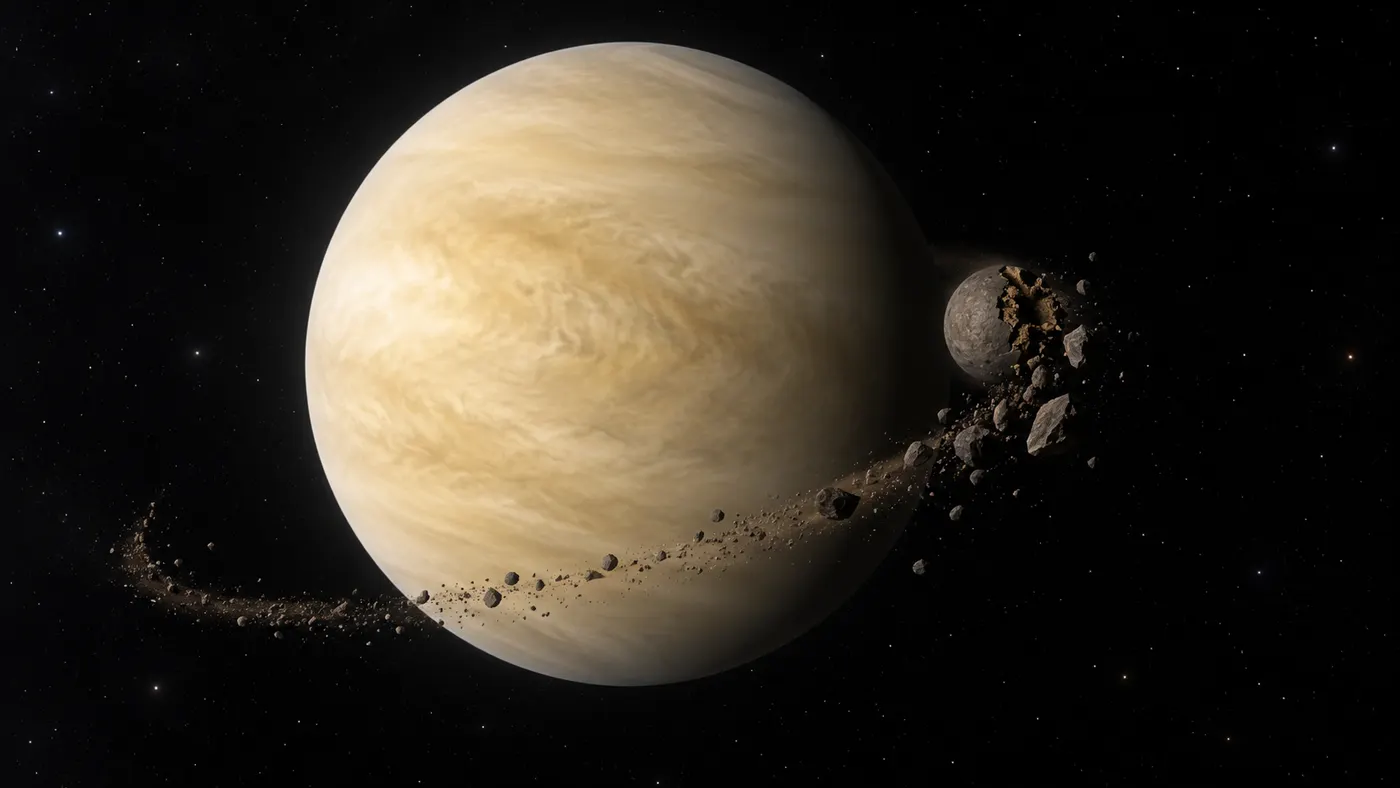
The simulations suggest that an ancient moon could have moved close enough for Venus’s tidal forces to tear it apart. The debris may temporarily have formed a ring around the planet before much of the material eventually fell onto Venus.
If such a moon existed, the researchers estimate that it was probably destroyed within the first billion years of the planet’s history. Simulations involving moons of different masses produced a similar outcome: eventually, their stable orbits were lost. The findings were also reported by Reuters.
There is still no proof that Venus once had a moon
The researchers stress that the study does not prove an ancient Venusian moon actually existed. Instead, it shows that if a large satellite formed around the young planet, Venus would have had difficulty keeping it until the present day.
Traces of such an ancient event could theoretically remain in the chemistry of Venus’s surface or atmosphere. Future NASA missions DAVINCI and VERITAS are expected to provide new information about the planet’s atmosphere, interior and geological history.