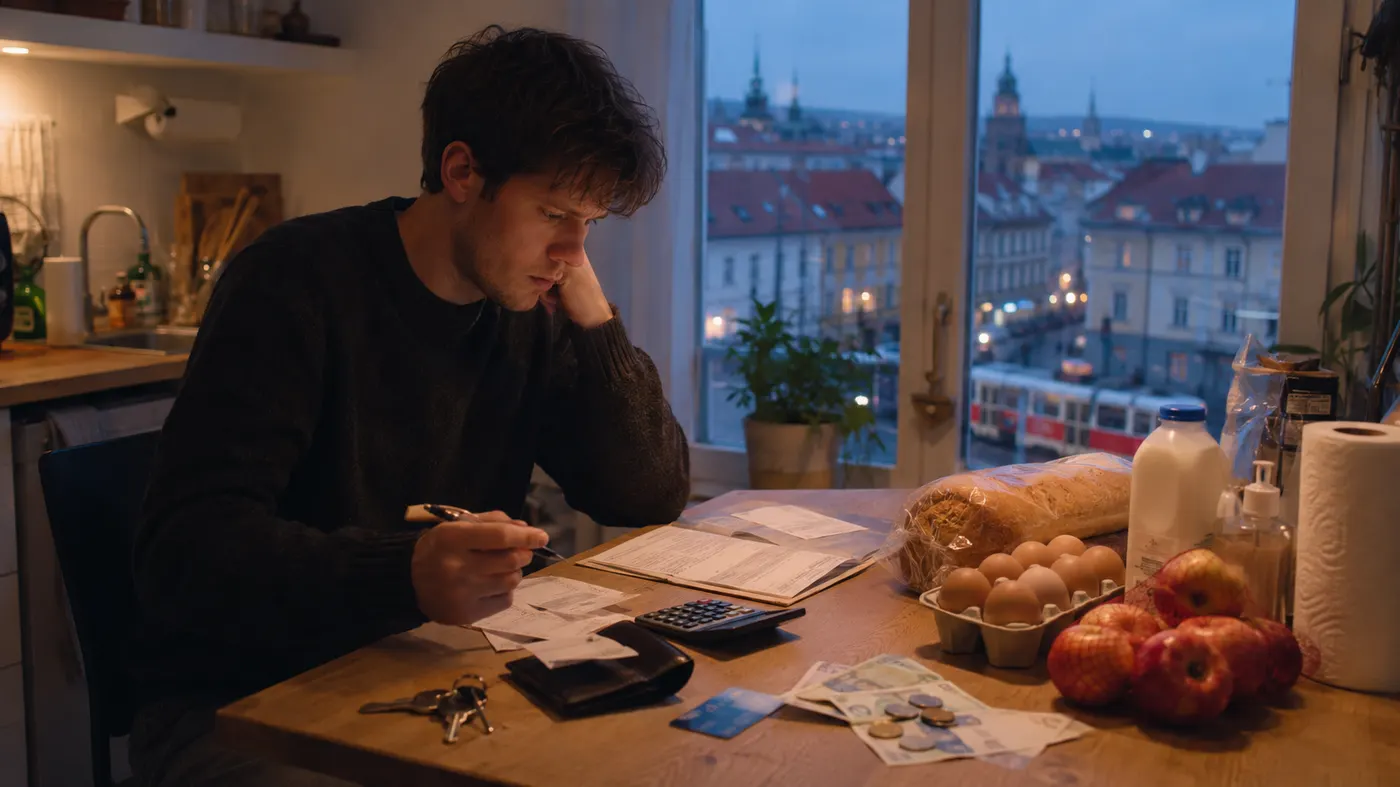
How Much Money Does One Person Need to Live in the Czech Republic: Rent, Food, Transport, and Real Expenses
The question “how much money do you need to live in the Czech Republic” sounds simple, but there is no universal answer. One person lives in a room, uses public transport, and cooks at home. Another rents a separate apartment, often eats out, and spends more on comfort. That is why the real cost of living depends not only on the city, but also on personal habits.
The main mistake is counting only salary and forgetting about expenses. On paper, the amount may look fine, but after rent, utilities, transport, food, mobile service, and everyday small costs, much less free money remains.
For a calm life in the Czech Republic, it is important to understand not only the average salary, but also how much money is spent every month. This is especially important in the first months after moving, when there is no financial reserve yet, no stable schedule, and no clear budget.
Why the average salary does not show real life
The average salary in the Czech Republic may look quite high, but it does not mean that most people receive exactly that amount in take-home pay. First, the average salary is calculated before taxes and mandatory deductions. Second, it is raised by high incomes in Prague, IT, finance, management, and large companies.
For everyday life, it is more important to look not only at gross salary, but also at net salary. Gross salary is the amount before deductions. Net salary is the money a person actually receives in their account. It is the net salary that should be compared with rent, food, transport, and other payments.
If a job offer states a salary of 35,000 Kč gross, it does not mean that the full amount will arrive on the card. That is why before accepting a job, it is important to clarify how much will actually be received after deductions.
The main expense is housing
The biggest expense in the Czech Republic is rent. This is especially true in Prague, Brno, and other large cities. Even if the salary is higher, a significant part of the income may go only toward housing.
There are several options:
- a room in an apartment;
- a place in a dormitory or workers’ accommodation;
- a studio or small apartment;
- a separate 1+kk or 1+1 apartment;
- housing provided by the employer;
- shared rental with a partner, friends, or colleagues.
A room is usually cheaper than a separate apartment, but offers less privacy. Separate housing is more comfortable, but requires a higher income and often a deposit. Employer-provided housing can help at the start, but the conditions should be checked in advance: price, number of people in the room, address, house rules, and what happens if the job ends.
Utilities and additional housing costs
When renting, it is important to look not only at the basic apartment price. Utilities, electricity, gas, internet, waste collection, or service advances are often paid separately.
Before signing a contract, you need to clarify:
- what is included in the rent;
- how much the utility advances are;
- how often the final settlement is made;
- who pays for internet;
- whether electricity or gas is paid separately;
- which payments may increase in winter;
- whether overpayments are returned after settlement.
Sometimes housing looks inexpensive only in the listing. After adding utilities, the final amount becomes noticeably higher.
How much money is spent on food
Food expenses depend heavily on habits. If you cook at home, buy products on sale, and do not often go to cafés, expenses can be kept under control. If you often eat out, buy ready-made food, and get coffee every day, the budget grows quickly.
Usually, most money is spent on:
- meat and fish;
- dairy products;
- vegetables and fruit;
- bread and grains;
- coffee and sweets;
- ready-made food;
- lunches at work;
- delivery.
The simplest way to save money is to plan shopping for several days, cook at home, and avoid buying small items every day in local convenience stores. It is these small daily expenses that often quietly consume a large part of the budget.
Transport: a smaller but necessary expense
Public transport in the Czech Republic is usually convenient, especially in large cities. For a person without a car, it is one of the most stable and predictable expenses.
Before choosing housing, it is worth considering not only the rent price, but also the commute to work. A cheap room far from work may turn out to be less profitable if you have to travel for a long time every day, make transfers, or pay for intercity transport.
If the job is shift-based, night transport should be checked separately. Sometimes the problem is not the ticket price, but the fact that it is difficult to get home after a late shift without a taxi.
Mobile service, internet, and everyday small expenses
After moving, expenses appear that people often forget about. These are not the largest amounts, but together they noticeably affect the budget.
- mobile service;
- home internet;
- household cleaning products;
- dishes;
- bed linen;
- medicine;
- seasonal clothing and shoes;
- minor repairs;
- documents and translations;
- trips for errands and paperwork.
In the first months, these expenses are especially noticeable because many things have to be bought again. A person may rent housing, start working, and only then realize that they need a blanket, a pot, a charger, a warm jacket, work shoes, or a transport pass.
Why the first month is usually the most expensive
The first month in the Czech Republic often costs more than a normal month. You need to pay for housing, a deposit, transport, food, mobile service, household items, and live until the first salary. At the same time, the first payment may arrive only after several weeks.
At the start, money may be spent on:
- the first rent payment;
- a housing deposit;
- agency commission, if there is one;
- a transport pass or tickets;
- food for the first weeks;
- a SIM card;
- household items;
- work clothes or shoes;
- document translations;
- unexpected expenses.
That is why it is risky to rely only on a future salary when moving. It is better to have a reserve that allows you to live calmly for at least a few weeks without panic.
Prague, Brno, and the regions: where life is more expensive
Prague usually offers more job opportunities, but expenses are also higher there. Rent, services, cafés, and some everyday costs in the capital can be noticeably more expensive than in smaller cities.
Brno is also among the more expensive cities, especially because of housing demand. In Plzeň, Ostrava, Liberec, Olomouc, and other cities, more affordable options can be found, but salaries and the number of job offers depend on the field.
That is why it is necessary to compare not only salary, but the combination of “income minus expenses.” Sometimes a job with a lower salary in a region can leave the same amount of money, or even more, than a higher salary in Prague after paying rent.
How to understand whether a salary is enough for normal life
Before accepting a job, it is worth calculating an approximate budget. It does not have to be perfectly accurate, but at least basic. This helps you understand whether the salary will be enough not only for survival, but also for a calm life.
The calculation should include:
- rent;
- utilities;
- food;
- transport;
- mobile service;
- medicine;
- clothing;
- documents;
- a reserve for unexpected expenses;
- money you want to save.
If almost nothing remains after mandatory expenses, such a salary may be difficult to live on, even if it looks normal at first glance.
Which expenses are most often underestimated
Many people calculate rent and food in advance, but forget about additional costs. These are often the expenses that break the budget.
- housing deposit;
- agency commission;
- winter clothing;
- commute to work;
- lunches outside the home;
- medication;
- document translations;
- phone or equipment repair;
- trips home;
- transport or parking fines;
- an unexpected move to another housing option.
Without a reserve, even one unexpected expense can create stress. That is why financial stability in the Czech Republic begins not with a high salary, but with proper planning.
How to save money without seriously lowering quality of life
Saving money does not necessarily mean living badly. Often it is enough to remove chaotic expenses and plan main payments in advance.
- look for housing with a convenient commute to work;
- cook at home several times a week;
- buy groceries on sale;
- use monthly or yearly transport passes;
- do not rent housing without understanding utility payments;
- compare mobile and internet prices;
- keep a small reserve;
- do not accept a job without a clear net salary.
The most useful habit is to count not only large purchases, but also recurring small expenses. Coffee, snacks, delivery, unnecessary trips, and spontaneous purchases can quietly become a separate large expense category.
Conclusion
For one person to live in the Czech Republic, it is necessary to count not an abstract average salary, but real monthly expenses. The main budget categories are rent, utilities, food, transport, mobile service, and a reserve for unexpected situations.
The biggest mistake is looking only at the salary in a job offer. It is important to understand how much money will actually arrive after deductions, how much will go toward housing, and how much will remain after mandatory payments.
Comfortable life begins when income covers not only rent and food, but also creates a small reserve. That is why before moving or changing jobs, it is better to calculate the budget in advance: city, housing, transport, food, documents, and first expenses before the salary arrives.