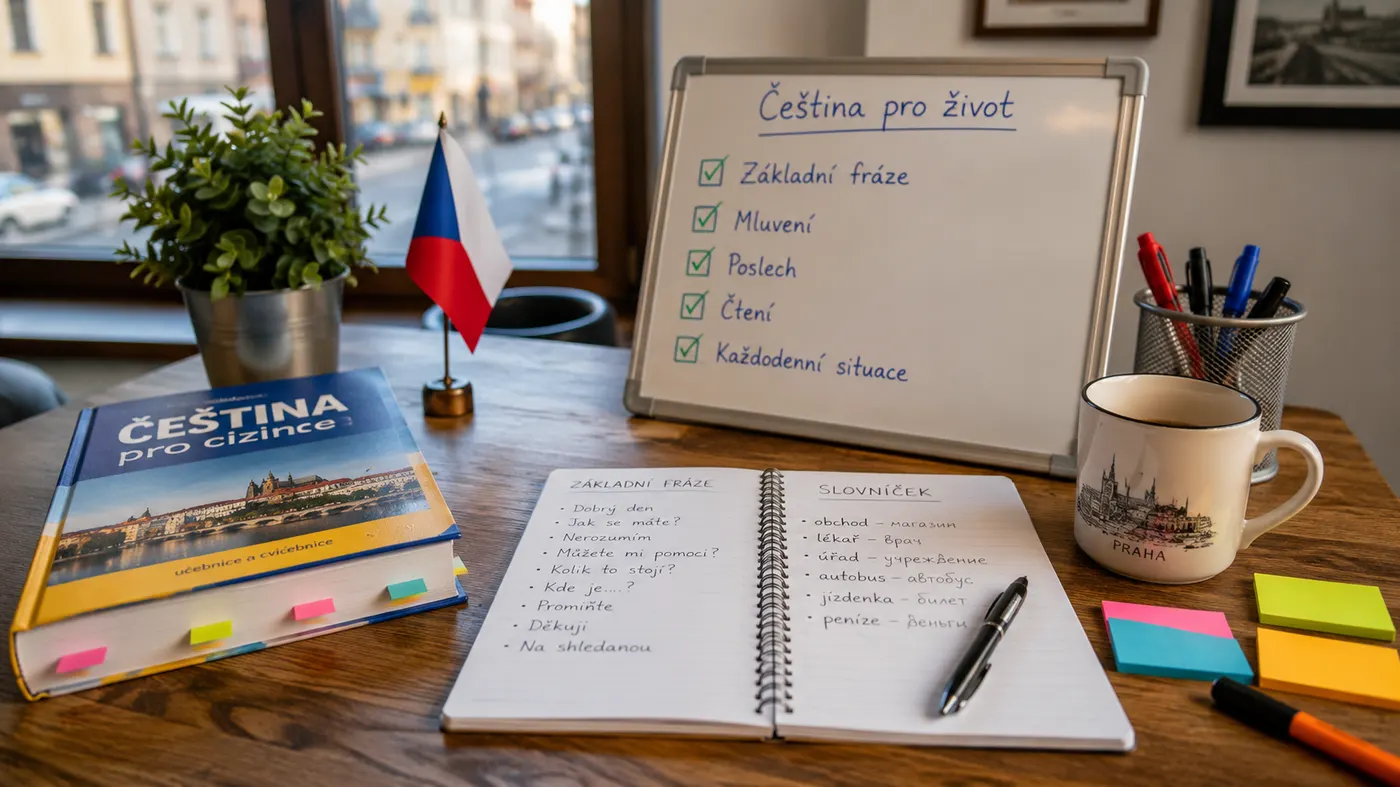
Czech for Life in the Czech Republic: What to Learn First After Moving
After moving to the Czech Republic, Czech is needed not only for work. It is needed in shops, transport, banks, clinics, when renting housing, and when speaking with a manager, apartment owner, doctor, or office worker. Even if a job is suitable without knowing the language, it is almost impossible to completely avoid Czech in everyday life.
The main mistake at the beginning is trying to learn the language like at school: long rules, tables, rare words, and grammar without a connection to real situations. After moving, this approach quickly becomes exhausting. A person works, deals with documents, looks for housing, counts money, gets used to a new country — and simply has no energy left for complicated studying.
It is much more useful to start with a practical minimum: phrases for work, renting, transport, shops, doctors, and documents. The goal of the first months is not to speak perfectly, but to understand basic situations and be able to explain simple things.
Why Czech should be learned through everyday situations
After moving, the language is needed not for an exam, but for life. Every day, a person comes across short phrases, signs, notices, text messages, emails, instructions, and questions. If you understand at least the basics, life becomes calmer.
First of all, Czech helps you:
- understand working conditions;
- ask about the schedule and break;
- communicate in a shop;
- buy a ticket or transport pass;
- call about a housing listing;
- read a simple message from an apartment owner;
- make a doctor’s appointment;
- understand a letter from an office;
- avoid depending on a translator every time.
Even level A1 is already useful. According to the description of the Common European Framework of Reference for Languages, levels A1 and A2 belong to the basic user of a language. In practice, this means that first you need to learn to understand the most common words, simple questions, and short answers.
What to learn first
The first stage is not the whole grammar of the Czech language. The first stage is words and phrases that will be genuinely useful today or tomorrow.
It is better to start with these topics:
- greetings and politeness;
- numbers, dates, and time;
- address, street, building, floor;
- work, shift, schedule, break;
- shop and groceries;
- transport and tickets;
- renting housing and utility payments;
- doctor, pain, medicine;
- documents and appointments;
- simple questions: where, when, how much, how, why.
If you learn exactly these topics, progress appears faster. A person starts recognizing words around them and stops feeling that the language is one huge wall.
Basic phrases for every day
First, you need to learn phrases that help you avoid silence in simple situations. They are needed almost everywhere: at work, in shops, in transport, at the doctor’s, and when speaking with a housing owner.
- Dobrý den — hello / good afternoon;
- Na shledanou — goodbye;
- Prosím — please;
- Děkuji — thank you;
- Promiňte — excuse me / sorry;
- Nerozumím — I do not understand;
- Můžete to zopakovat? — can you repeat that?
- Mluvte prosím pomalu — please speak slowly;
- Potřebuji pomoc — I need help;
- Kde je...? — where is...?
These phrases do not make a person fluent, but they give the most important thing — the ability to stop a conversation, ask someone to repeat, clarify something, and not get lost.
Numbers, dates, and time
Numbers are needed constantly in the Czech Republic. Without them, it is hard to understand prices, salary, schedules, bus numbers, appointment dates, floors, office numbers, or amounts in a contract.
First, you need to learn:
- numbers from 1 to 100;
- hundreds and thousands;
- days of the week;
- months;
- telling time;
- dates;
- the words today, tomorrow, yesterday;
- morning, day, evening, night.
Useful words:
- Kolik? — how much / how many?
- Kdy? — when?
- Dnes — today;
- Zítra — tomorrow;
- Včera — yesterday;
- Ráno — in the morning;
- Večer — in the evening;
- Hodina — hour;
- Minuta — minute.
If a person understands numbers and time, it becomes easier to work according to a schedule, read timetables, buy tickets, and arrange meetings.
Czech for work
At work, language is needed even when a job is listed as “without Czech”. A manager, shift supervisor, or colleague may still say where to go, what to take, when the break is, where the changing room is, and what to do next.
For the first job, it is important to learn these words:
- práce — work;
- směna — shift;
- ranní směna — morning shift;
- noční směna — night shift;
- přestávka — break;
- šatna — changing room;
- vedoucí — manager, supervisor;
- smlouva — contract;
- mzda — salary / wage;
- výplata — salary payment / payday.
Useful phrases:
- Jsem tady první den — I am here for the first day;
- Co mám dělat? — what should I do?
- Kdy začíná směna? — when does the shift start?
- Kdy je přestávka? — when is the break?
- Kde je šatna? — where is the changing room?
- Je to správně? — is this correct?
- Nevím — I do not know;
- Potřebuji vysvětlit — I need an explanation.
At the beginning, you do not need to know complicated work terms. First, it is more important to understand instructions, safety, the schedule, and basic duties.
Czech for renting housing
When looking for housing, Czech is especially important. You need to understand the price, deposit, utility payments, rental period, address, contract terms, and house rules.
First, it is worth learning:
- byt — apartment;
- pokoj — room;
- nájem — rent;
- nájemní smlouva — rental contract;
- kauce — deposit;
- poplatky — fees / payments;
- energie — utilities / energy;
- adresa — address;
- majitel — owner;
- prohlídka — viewing.
Useful phrases:
- Je byt ještě volný? — is the apartment still available?
- Kolik je nájem? — how much is the rent?
- Kolik je kauce? — how much is the deposit?
- Jsou poplatky v ceně? — are the fees included in the price?
- Je možná registrace adresy? — is address registration possible?
- Kdy je možná prohlídka? — when is a viewing possible?
- Můžete mi poslat smlouvu? — can you send me the contract?
These phrases help you avoid depending completely on a translator and let you clarify the main conditions immediately before paying a deposit.
Czech for transport
Transport in the Czech Republic is convenient, but during the first weeks it is easy to get confused by tickets, zones, transfers, and timetables. That is why transport words are better learned right away.
- jízdenka — ticket;
- zastávka — stop;
- nádraží — railway station;
- vlak — train;
- autobus — bus;
- tramvaj — tram;
- metro — metro;
- přestup — transfer;
- zpoždění — delay;
- směr — direction.
Useful phrases:
- Kde je zastávka? — where is the stop?
- Kam jede tento autobus? — where does this bus go?
- Musím přestoupit? — do I need to transfer?
- Kde si koupím jízdenku? — where can I buy a ticket?
- Jak dlouho platí jízdenka? — how long is the ticket valid?
- Jede to do centra? — does this go to the center?
If you understand basic transport words, it is easier to use apps, read boards, and not be afraid of traveling to other districts or cities.
Czech for shops and everyday purchases
A shop is one of the best places to practice because the situations repeat every day. Simple words are needed there: groceries, price, bag, card, cash, receipt.
- chléb — bread;
- mléko — milk;
- voda — water;
- maso — meat;
- zelenina — vegetables;
- ovoce — fruit;
- taška — bag;
- účtenka — receipt;
- hotově — in cash;
- kartou — by card.
Useful phrases:
- Kolik to stojí? — how much does it cost?
- Máte tašku? — do you have a bag?
- Budu platit kartou — I will pay by card;
- Budu platit hotově — I will pay in cash;
- Potřebuji účtenku — I need a receipt;
- Kde najdu...? — where can I find...?
Through shops, you can quickly get used to pronunciation, numbers, and simple questions. This is everyday practice without a separate lesson.
Czech for doctors and pharmacies
Medical situations are better prepared in advance, not at the moment of illness. Even a few words help explain what hurts and what kind of help is needed.
- lékař — doctor;
- lékárna — pharmacy;
- bolest — pain;
- hlava — head;
- břicho — stomach / belly;
- zub — tooth;
- teplota — temperature / fever;
- kašel — cough;
- recept — prescription;
- pojištění — insurance.
Useful phrases:
- Bolí mě hlava — my head hurts;
- Bolí mě zub — my tooth hurts;
- Mám teplotu — I have a fever;
- Potřebuji lékaře — I need a doctor;
- Máte volný termín? — do you have an available appointment?
- Mám zdravotní pojištění — I have health insurance;
- Potřebuji recept — I need a prescription.
If you have chronic illnesses or regular medication, it is better to save the names of symptoms and medicines in Czech on your phone in advance.
Czech for documents and offices
Documents are one of the most difficult areas because deadlines, exact wording, and letters in Czech matter there. You do not need to understand legal language completely right away, but basic words are worth learning.
- doklad — document;
- pas — passport;
- pobyt — residence / stay;
- žádost — application;
- termín — date / appointment / scheduled time;
- úřad — office / authority;
- cizinecká policie — foreign police;
- ministerstvo vnitra — Ministry of the Interior;
- potvrzení — confirmation;
- podpis — signature.
Useful phrases:
- Mám termín — I have an appointment;
- Potřebuji podat žádost — I need to submit an application;
- Potřebuji potvrzení — I need confirmation;
- Kde mám podepsat? — where should I sign?
- Jaké doklady potřebuji? — what documents do I need?
- Můžete mi to napsat? — can you write it down for me?
If an official letter arrives, it must not be ignored. You need to translate the text, find the response deadline, and understand whether action is required.
Why A1 is a normal first goal
After moving, you do not need to immediately set the goal of “speaking fluently.” This is too big a task, and many people quickly give up because of it. It is better to set the first realistic goal — level A1 in everyday situations.
At level A1, a person learns to:
- understand familiar words;
- introduce themselves;
- ask simple questions;
- understand slow speech;
- read simple notices;
- use basic phrases in shops, transport, and at work.
The description of levels can be found in the official Europass — CEFR language skills system. For life after moving, A1 is not “too little”, but an important base from which independence begins.
When A2 is needed
A2 is the next practical level. It helps not only to survive in simple situations, but also to explain everyday issues more confidently: work, housing, shopping, transport, health, family, and documents.
For some people, level A2 is also important for documents. The official portal for the Czech language exam for permanent residence states that the A2 exam is used for applicants for permanent residence, and from 11 April 2026 the exam is held in an updated format. Information can be checked on the website Čeština pro cizince — Czech Language Exam for Permanent Residence.
This does not mean that you need to prepare for the exam immediately after moving. But it is useful to understand the direction: first everyday A1, then confident A2, and after that the language for work, documents, and long-term life.
How to learn Czech when you have little time
After work, there is rarely enough energy for long lessons. That is why it is better to use a short but regular system.
- learn 5–10 words a day;
- repeat phrases on the way to work;
- save new words on your phone;
- translate real messages, not random texts;
- learn words by topic: work, housing, doctor, transport;
- speak briefly, even with mistakes;
- repeat the same phrases until they become automatic;
- listen to how shop assistants, colleagues, and drivers speak;
- repeat old words once a week.
It is better to study for 15 minutes every day than to try to complete one big lesson once a week. Language is remembered through repetition and real situations.
Which mistakes prevent people from speaking faster
Many people study Czech for a long time but almost never use it in real life. Because of this, the language remains passive: a person recognizes words but is afraid to speak.
Common mistakes:
- waiting for perfect pronunciation;
- being afraid of mistakes;
- studying only grammar;
- not repeating old words;
- learning rare words instead of everyday words;
- constantly switching to a translator;
- postponing the language “until there is free time”;
- not using Czech in shops, transport, and at work.
Mistakes at the beginning are normal. It is much worse to stay silent for months and wait for the moment when the language appears by itself. It appears through use.
What should be in a personal vocabulary
A good habit is to keep a personal vocabulary not based on a textbook, but on your own life. It should include words that you genuinely meet every day.
Sections of a personal vocabulary can include:
- my work;
- my schedule;
- my address;
- transport to work;
- renting and housing;
- shop and groceries;
- doctor and pharmacy;
- documents;
- frequent questions;
- phrases I am afraid to say.
This kind of vocabulary works better than random lists from the internet because it is connected to real life. If you need a word every day, you will remember it faster.
Conclusion
Czech for life in the Czech Republic should start not with rare words and complicated grammar, but with practical situations. First, it is worth learning phrases for work, housing, transport, shops, doctors, and documents.
At the beginning, A1 is enough as a goal: understanding simple words, asking short questions, asking someone to repeat, and explaining basic things. After that, you can move toward A2 — a level that helps handle everyday matters more confidently and may be needed for permanent residence.
The most practical approach is to learn a little every day, immediately use words in real life, and not be afraid of mistakes. The sooner a person starts using Czech in simple situations, the faster the Czech Republic becomes more understandable and calmer for everyday life.